


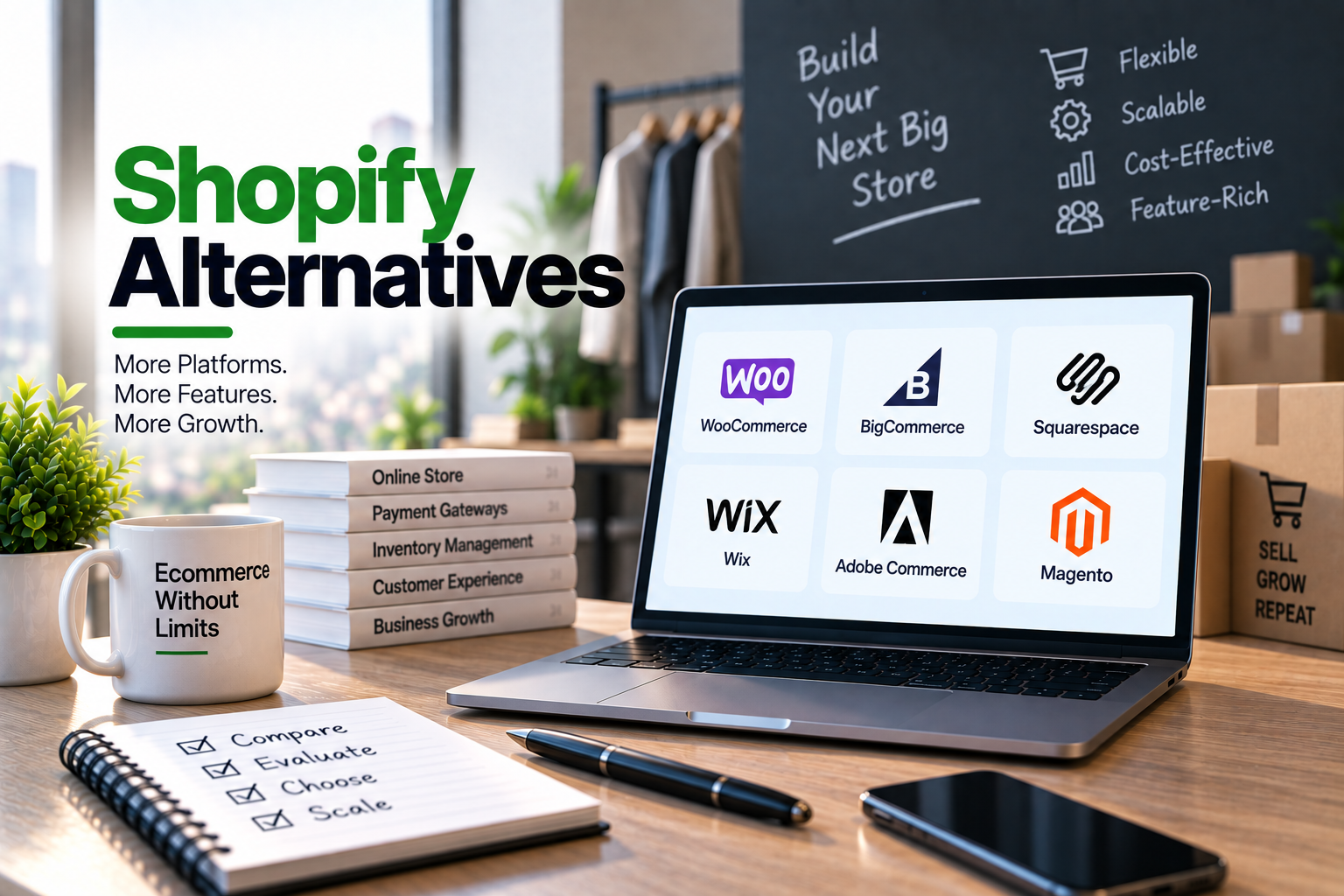
Shopify Alternatives
Teams look at Shopify alternatives for one of three reasons: transaction fees and platform costs at volume, customisation that the platform constrains, or a requirement to own the stack. Those point to different categories entirely, and choosing the wrong one produces a migration that solves nothing. This page covers the full field sorted by how much control you take on, from hosted platforms through open source to headless architectures, with the migration costs each involves.
Establish Which Constraint You Have Hit
Migration is expensive enough that identifying the actual problem first is worth the hour it takes. These four are what teams usually mean.
Platform and Transaction Costs
Fees that scale with revenue become significant at volume, particularly where payment processing is not on the platform’s own gateway.
Customisation Limits
Checkout, pricing logic, and unusual product models are where hosted platforms constrain most. If the constraint is elsewhere, migration may not help.
Data Ownership and Residency
Where regulation or policy requires the store and customer data to sit in infrastructure you control, hosted platforms are excluded regardless of merit.
Integration Depth With Back Office
Where the store must integrate tightly with ERP, warehouse, or finance systems. Our ERP integration work addresses this without necessarily changing platform.
Hosted Platform Alternatives
If you want to stay on a managed platform and simply change vendors, this is the category. The trade-offs are commercial and structural rather than a fundamental change in model.
BigCommerce
The closest structural comparison, positioned with fewer transaction fee constraints and more built-in functionality before apps are required.
Wix and Squarespace Commerce
Suited to smaller catalogues where the site matters as much as the store, and where commerce requirements are straightforward.
What Changing Hosted Platforms Actually Solves
Fee structure and specific feature gaps. It does not solve fundamental customisation limits, since you remain inside someone else’s platform.
What to Check First
Whether your required apps and integrations exist on the target platform. Our ecommerce development scoping checks this before recommending a move.
Open Source and Self-Hosted
Taking ownership of the stack changes cost structure, control, and responsibility simultaneously. This is the right category where customisation or data ownership is the binding constraint.
WooCommerce
The most widely deployed open-source option, running on WordPress, with an enormous extension ecosystem and full access to the underlying code.
Detailed Comparison
[LINK SLOT: your live WooCommerce versus Shopify comparison page]
Adobe Commerce and Magento Open Source
Suited to larger catalogues and complex commercial rules, with considerably higher implementation and operational requirements than lighter options.
Shopware and Similar European Platforms
Established open-source commerce platforms with strong B2B capability, frequently overlooked in comparisons written for the North American market.
What Self-Hosting Requires
Hosting, security patching, performance management, and PCI scope handling. Our cloud consulting work covers this where teams lack the capability.
Headless and Composable Commerce
Separating the storefront from the commerce engine is a different architecture rather than a different platform, and it suits organisations with specific frontend requirements or multiple sales channels.
What Headless Actually Means
The commerce engine provides APIs, and you build the storefront separately. Full frontend control in exchange for building and maintaining that frontend.
Open Source Headless Engines
Medusa and Saleor provide the commerce backend as code you control, suited to teams with engineering capacity and unusual requirements.
Enterprise Composable Platforms
commercetools and comparable platforms serve large organisations selling across many channels and regions with complex catalogue and pricing rules.
When Headless Is the Wrong Answer
For a single conventional storefront, headless adds engineering cost without adding value. Our web application development work recommends it only where the requirement justifies it.
Migration Realities
Commerce migration carries risks other platform migrations do not, because the store is directly revenue-generating and mistakes are visible to customers and to search engines immediately.
URL Structure and Redirects
Product and category URLs change between platforms. Without complete redirect mapping, established search rankings are lost, and this is the most common and most expensive migration failure.
Payment and Checkout Reconfiguration
Payment providers, tax configuration, and checkout flow all need rebuilding and testing with real transactions. Our payment gateway integration work covers this.
Data Migration Beyond Products
Customers, order history, reviews, and subscriptions all need migrating, and order history in particular is frequently underestimated.
Apps and Extensions Do Not Transfer
Every app used on the old platform needs a replacement or custom build. This is regularly the largest hidden line item.
Migrate During a Quiet Period
Never during a peak selling season. The window matters more than the schedule, and this constraint frequently determines timing.
FAQs
What is the best Shopify alternative?
It depends on the constraint. BigCommerce for staying hosted with different fee structure, WooCommerce or Adobe Commerce for self-hosted control, Medusa or Saleor for headless with engineering capacity, and commercetools for enterprise multi-channel.
Is WooCommerce better than Shopify?
Different rather than better. WooCommerce gives full code access, no platform transaction fees, and data ownership, in exchange for you handling hosting, security patching, performance, and maintenance. Shopify handles all of that for you.
When does headless commerce make sense?
When you have specific frontend requirements, multiple sales channels, or unusual catalogue and pricing logic, plus the engineering capacity to build and maintain a storefront. For a single conventional store it adds cost without value.
What is the biggest risk when migrating a store?
Losing search rankings through incomplete URL redirect mapping. Product and category URLs change between platforms, and without a complete redirect plan the traffic loss is immediate, severe, and slow to recover.
Do apps transfer between commerce platforms?
No. Every app or extension needs a replacement or custom build on the new platform, and this is regularly the largest hidden cost in a commerce migration. Inventory what you actually use before estimating.
Will self-hosting a store save money?
Only once platform fees exceed hosting plus maintenance plus the engineering time to run it. Below meaningful revenue, hosted platforms are cheaper in total once your team’s time is counted honestly.